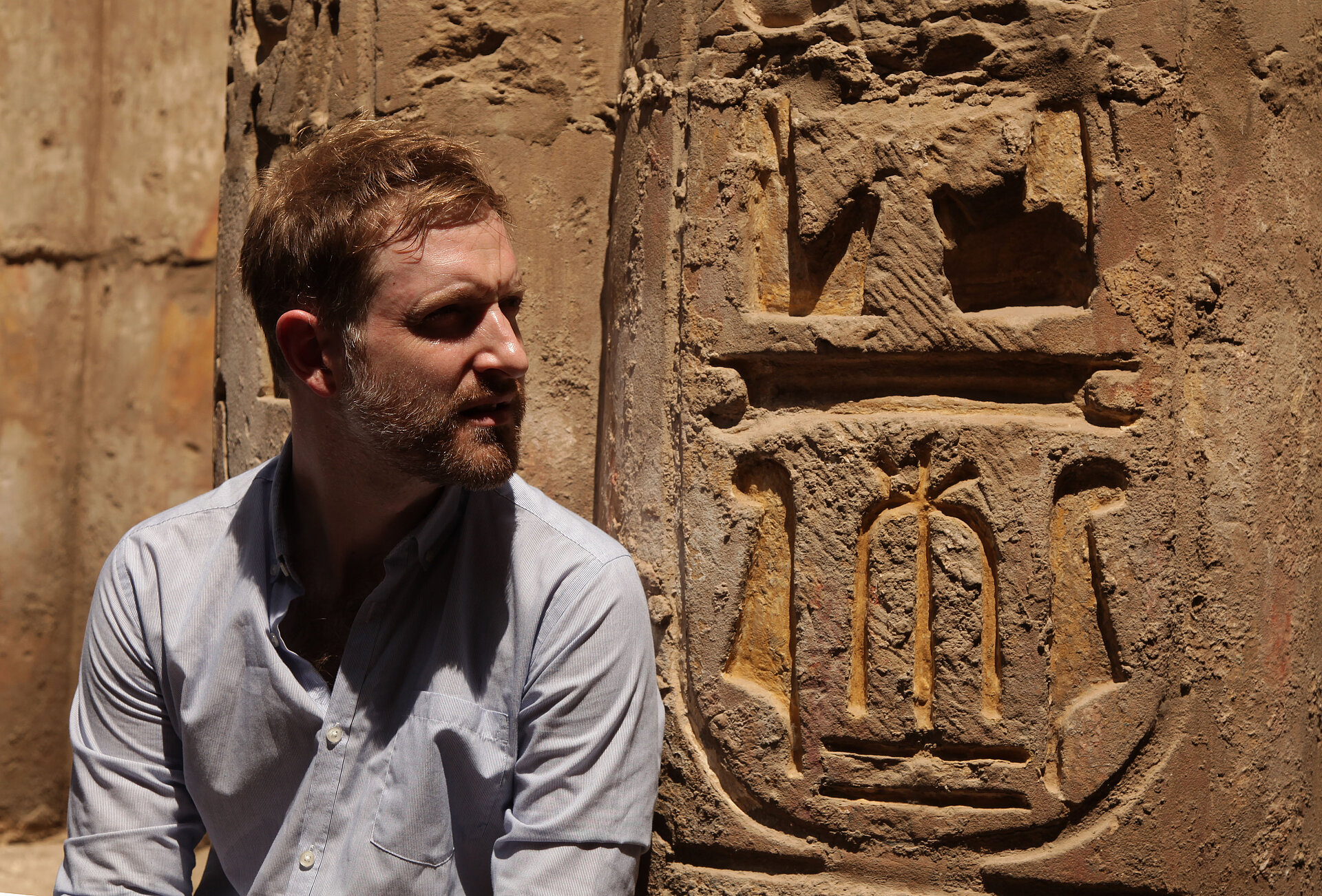
Chris Naunton is a prominent British Egyptologist, author and television presenter, widely recognised for his work in popularising the history of ancient Egypt.
Throughout his career, he has served as Director of the Egypt Exploration Society and has gained widespread popularity through his participation in documentaries for broadcasters such as the BBC, Channel 4 and National Geographic, including programmes such as Tutankhamun: The Mystery of the Burnt Mummy.
Here we talk to Chris about his career history, his involvement in Tutankhamun: The Immersive Exhibition and Cleopatra: The Immersive Experience, and why their stories continue to capture the imagination of people today.
Q: Could we start with how you first fell in love with Egypt?
I went to the University of Birmingham and out of everything I studied, Egypt was the thing that grabbed me most. There’s something about it that’s incredibly alluring. For someone from the suburbs of southwest London, it felt exotic. There’s this romantic idea of going out into the desert, putting a spade in the ground and uncovering incredible things.
Ancient Egyptian art and material culture also played a huge part. It’s so rich, colourful and visually striking. The symmetry, clean lines and bold colours really appealed to me aesthetically.
About three months after finishing my Master’s degree I got my first proper job in the field.
Q: Was that your first experience of going out to Egypt?
At Birmingham it was compulsory to go on what they called a “study tour” at the end of your second year. The university would give you a few hundred pounds and you had to spend four weeks somewhere relevant to your studies. At that point I was a complete homebody and definitely didn’t have the travel bug. But because I’d become so interested in ancient Egypt, I found myself choosing Egypt.
Suddenly, aged 20, I was heading there for four weeks with a group of fellow students.
Egypt was everything I expected it to be, noisy, dirty, chaotic, overwhelming and I found parts of it really difficult. But at the same time it was absolutely amazing and I loved it. It completely supercharged my interest in the subject. When I returned to the UK I went straight to Waterstones, bought books on Egypt and immersed myself in them. That was the moment I knew I was hooked, because I found myself reading about ancient Egypt purely for pleasure rather than for university.
Q: What was the first artefact or discovery that really stayed with you?
When I first worked in Egypt properly, I joined an American excavation project at Abydos, a remote site about three hours north of Luxor. Abydos was one of the great pilgrimage sites of ancient Egypt and also an important royal cemetery. The main monument there is the extraordinary temple built by Seti I, one of the most beautiful surviving temples in Egypt.
In those days tourists could only spend a very short amount of time there because of security restrictions, but I got to live there in the desert for five weeks while working on the excavation. The project was excavating an ancient settlement, including houses and everyday objects, which is actually quite rare in Egypt because so few ancient towns survive.
My own job was mostly drawing pottery, which if I’m honest was fairly boring, but just being there was extraordinary. Interestingly, the day before I arrived the team had discovered what’s known as a magical birth brick. In ancient Egypt, women gave birth while positioned on decorated mud bricks covered in protective magical imagery linked to gods and goddesses. Very few survive, so finding one was incredibly exciting.
Q: How did the broadcasting and writing side of your career happen?
Honestly, I was just incredibly lucky.
Before I even started my PhD, I applied for lots of jobs with no real expectation of getting any of them. One of those jobs was a fairly junior role at the Egypt Exploration Society, the UK’s main organisation connected to archaeological fieldwork in Egypt.
The job itself wasn’t academic, but in Egyptology there are so few positions available that anything remotely connected to the field is valuable. I absolutely loved it. I was 22 years old and suddenly surrounded by Egyptologists, books, archives and even paintings by Howard Carter leaning against the walls.
Over time I started giving lectures, writing articles and joining archaeological projects. Part of my role involved managing the library, and TV companies regularly visited to use it, so I often became the person they spoke to.
Then, about ten years later, the BBC were making a major documentary and asked if I’d like to appear in it. At the time there was growing interest in using genuine experts rather than traditional presenters. Obviously the answer was yes.
I did a screen test, which thankfully went well enough that they asked me back. Once you appear on television once, other opportunities begin to follow. Publishers got in touch, more documentaries happened, and eventually I became Director of the Egypt Exploration Society. After 16 years I left to become a full-time freelancer, focusing on television, books, lectures and tours. Even then, I never really expected it all to work. But somehow it did.
Q: More recently you’ve been involved with immersive exhibitions involving Tutankhamun and Cleopatra. Were those figures you’d always been interested in?
It might surprise people, but you can actually get all the way through a PhD in Egyptology without specialising in either Tutankhamun or Cleopatra. In academia there’s sometimes a tendency to avoid the most famous subjects because everyone already talks about them.
But television changes that, because broadcasters naturally focus on the biggest and most compelling stories. Tutankhamun and Cleopatra are famous for a reason, they’re simply fantastic stories.
By the time these exhibitions came along, I’d already researched both figures extensively through books and documentaries, particularly while exploring themes like lost tombs and royal history.
Q: What was your contribution to the exhibitions?
My involvement really began once the exhibitions came to the UK. The main curator is an incredible Spanish Egyptologist called Nacho Ares, who I’ve known for many years, and I helped refine some of the interpretation and contextual material for UK audiences.
I think exhibitions like these are incredibly important. Egyptology survives because people remain interested in it, so we can’t afford to be complacent. Traditional lectures, books and museum displays will always matter, but we also need to embrace new technologies and new ways of storytelling.
When I was younger, television documentaries first sparked my interest in archaeology. Today, younger audiences engage through immersive experiences, gaming, virtual reality and interactive storytelling. That’s why I think these exhibitions are so exciting. They use technology in a compelling way while still telling the history properly. Not everyone can jump on a plane to Egypt or even make it to the British Museum, so exhibitions like this give people another way into these stories.
Q: Why do you think Tutankhamun and Cleopatra continue to capture people’s imaginations more than anyone else from ancient Egypt?
Because they both have extraordinary stories that feel almost too dramatic to be real.
With Tutankhamun, you have this boy king who came to the throne as a child, died as a teenager, and was buried with the most spectacular treasure ever discovered. Then there’s the gold death mask, one of the most recognisable images in the world, which gives us this incredibly human connection to someone who lived more than 3,000 years ago. Add in the mystery surrounding his death and the incredible discovery of his tomb, and it becomes an irresistible story.
Cleopatra fascinates people for completely different reasons. She was one of the most powerful women of the ancient world, a ruler who stood at the centre of the struggle between Egypt and Rome. Her relationships with Julius Caesar and Mark Antony combine politics, romance and ambition in a way that still feels cinematic today. Then there’s the legendary ending - betrayal, war, tragedy and ultimately suicide, a story so dramatic Shakespeare turned it into one of his greatest plays.
What makes both of them so enduring is that these aren’t myths or fictional characters. They were real people. We can still see their tombs, statues, jewellery and inscriptions. That combination of history, mystery, spectacle and real human drama is incredibly powerful, and it’s difficult to think of many stories from the ancient world that rival them.
For more information please contact Warren Higgins, warren@chuffmedia.com
TUTANKHAMUN: THE IMMERSIVE EXHIBITION
The NEC Campus in Birmingham, 19 June - 13 September
Immerse LDN, Excel London Waterfront, until 12 July